
Living with a disability and relying on a Service Dog can already bring daily challenges — and facing discrimination makes those moments even harder. Being denied entry, questioned, or mistreated because of your Service Dog can be painful and frustrating.
You’re not alone. In a peer-reviewed US study of 482 Service Dog handlers, 68% reported daily discrimination, and 42% said they received invasive personal questions that go far beyond what the Americans with Disabilities Act (ADA) Service Dog laws allow.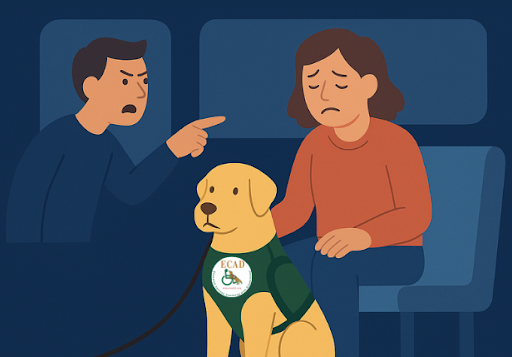
Most of the time, these situations happen not out of cruelty, but from misunderstanding or lack of training. That doesn’t excuse the behavior — but it does create an opportunity for education, advocacy, and change.
You and your Service Dog deserve respect and access wherever you go. Keep reading to learn how to handle Service Dog discrimination with confidence, understand your ADA rights, and know how to report Service Dog discrimination when it happens.
Know Your Rights (US Context)
Before you can respond confidently to discrimination, it helps to know precisely what the law says about your rights.
Under the ADA, a service animal is a dog — or in some cases, a miniature horse — trained to perform specific tasks related to your disability. Businesses and public spaces must allow Service Dogs anywhere the public is permitted, even if they typically prohibit pets.
If your need for a Service Dog isn’t apparent, staff can ask only two questions:
- Is the dog required because of a disability?
- What work or task does the dog perform?
They cannot ask about your disability, request proof or certification, or require your dog to demonstrate a task.
Businesses also cannot charge pet fees or deposits, and they can only ask you to remove your dog if:
- The dog is out of control, and you don’t take corrective action.
- The dog isn’t housebroken.
- The dog’s presence would fundamentally change the nature of the service (which is rare).
Allergies or fear of dogs are not valid reasons to deny access.
Other relevant laws include the Fair Housing Act, which protects people who use Service Dogs in housing settings.
A Compassionate Response Plan
When someone questions your right to have your Service Dog or refuses you access, it can feel frustrating and hurtful. In that moment, it helps to pause, take a breath, and respond with calm confidence. You’ve worked hard to live independently with your service partner, and you deserve to be treated with respect wherever you go.
Having a simple plan can make those difficult moments easier to handle. Here are a few compassionate steps to guide you:
- Educate calmly.
You can say: “Under the ADA, Service Dogs are allowed in all public areas. You may ask only if the person needs the dog for a disability and what tasks the dog performs.” Many refusals happen out of misunderstanding, not malice. A brief, confident statement often clears up confusion. - Offer a safe compromise.
For instance: “I can keep my dog close or on a leash — perhaps that helps ease your concern?” Flexibility can defuse tension without giving up your rights. - Document the encounter.
Note the time, place, and people involved. Take photos of signs or barriers that contributed to the problem — these details help if you later file a complaint. - Escalate politely.
Ask for a manager or higher authority. Getting the right person involved can resolve the situation quickly. - Take further action if needed.
If you can’t resolve the issue, file a formal complaint or contact a disability rights organization or an attorney. Speaking up helps protect not just your rights but those of others who rely on Service Dogs.
Tip: Carry a small ADA rights card to hand to staff when needed — a simple, respectful way to educate and de-escalate.
Each time you respond with calm confidence, you’re not only standing up for yourself but helping create a more understanding world for everyone who depends on a Service Dog. And if education isn’t enough, knowing how and where to file a complaint ensures your experience helps drive lasting change.
When and How to File a Complaint
Sometimes, even when you stay calm and explain your rights, the situation doesn’t improve. If a business still refuses entry or challenges your Service Dog’s legitimacy, you have every right to take the next step — and doing so helps protect not only your rights but those of others who rely on Service Dogs.
Here are your main options:
- File a complaint with the US Department of Justice (DOJ).
The DOJ investigates violations of the ADA involving public spaces and government entities. You can file online at ada.gov/file-a-complaint. - Contact your state or local civil rights agency.
Many states and cities have agencies that enforce disability rights laws and can mediate or investigate complaints. - Submit a housing complaint to the US Department of Housing and Urban Development (HUD).
If a landlord or housing provider denies you because of your Service Dog, file a complaint through HUD at hud.gov/complaint. - Reach out to a disability rights organization or attorney.
The National Disability Rights Network can connect you with local advocates who understand ADA law and can guide you through the process.
Tip: Taking action doesn’t just resolve your case — it helps create more understanding and accountability for everyone who depends on a Service Dog.
Filing a complaint takes courage, and it’s normal to feel drained afterward. Even when you do everything right, these moments can leave an emotional mark. That’s why it’s equally important to care for your well-being. In the next section, we’ll explore how to protect your emotional health, build resilience, and find strength through community and support.
Emotional Care and Personal Resilience
Standing up for your rights can be empowering, but it can also be draining. Encounters that question your legitimacy or deny you access can leave you feeling angry, shaken, or discouraged — and that’s completely normal. Caring for your emotional well-being is just as important as knowing your legal rights.
Here are a few ways to regain balance and strengthen your resilience:
- Acknowledge your feelings.
It’s okay to feel frustrated or exhausted. Give yourself space to process what happened. - Reach out for support.
Talk with trusted friends, family, or other Service Dog handlers. Being heard by someone who understands can ease the emotional weight. - Find calm and grounding.
Deep breathing, mindfulness, or simply taking a quiet walk with your dog can help you reset. - Prepare with confidence.
Rehearsing calm responses can make future encounters easier to handle. - Share your experience.
Telling your story — whether privately or publicly — helps raise awareness and encourages change. - Recognize your strength.
Each time you handle a challenge with grace, you lead by example and show the world what inclusion truly means.
Remember: You and your Service Dog are a team. Every challenge you overcome together strengthens that bond — and reminds you that your independence and dignity matter.
Help Us Transform the Lives of People Living With Disabilities
You deserve to move through the world with respect, dignity, and full access — just as anyone else. While discrimination can feel daunting and personal, you don’t have to face it alone. Ground yourself in your rights, lean on your community, document what you can, and know that every time you advocate for yourself, you pave the way for others.
Whether you donate, volunteer, or simply share what you’ve learned, you’re helping change lives one paw at a time.