

Fake Service Dogs: The Growing Problem and Its Impact
Service Dogs are indispensable to individuals with disabilities, keeping them safe, enabling their independence, and improving their quality of life. Unfortunately, the proliferation of fake service dogs has become a growing concern recently. Fake service dogs are more than a minor nuisance; they pose real challenges for businesses, communities, animals, and individuals who genuinely rely on them.
The surge of fake service dogs threatens to undermine the integrity and efficacy of these amazing animals. Understanding the issue and its implications can enable us to work together to create an environment that respects the rights of individuals with disabilities while safeguarding public interests. Continue reading to learn about the rise of fake service dogs, its ramifications, and the need for stricter regulation and public awareness.
Understanding the Role of Genuine Service Dogs

Legitimate Service Dogs are specially trained to perform specific tasks for individuals with disabilities. Whether it’s assisting people with mobility issues, veterans battling post-traumatic stress disorder (PTSD), or a child with autism, these dogs play an invaluable role.
The Rise of Fake Service Dogs
Unfortunately, as the value and recognition of Service Dogs have increased, so has the temptation for people to pass off their regular dogs as Service Dogs. There’s a growing market for counterfeit Service Dog certifications, vests, and IDs, making it easier for pet owners to claim their dog as a Service Dog. However, according to the Americans with Disabilities Act (ADA), Service Dogs are not required to be certified or wear identifying vests or tags.
There are several possible reasons behind the trend. For instance, some people confuse emotional support animals (ESAs) with Service Dogs. While ESAs provide comfort, they do not have the same legal rights as Service Dogs. In addition, some unscrupulous people want to take their dogs to places where pets are generally not allowed, like restaurants, planes, or shopping centers, and want to avoid any applicable pet fees.
The Impact on People with Disabilities
People with actual needs suffer the most from this growing issue. Fake Service Dogs, often not adequately trained, can create a hostile environment for real Service Dogs, leading to increased scrutiny, discrimination, safety risks, and negative perceptions of Service Dogs.
Public Safety Concerns
Fake Service Dogs pose significant public safety risks. Untrained dogs may act aggressively, causing harm to people, including those with actual trained Service Dogs.
The Welfare of the Animals
The welfare of dogs misrepresented as Service Dogs is another concern. These pets are often subjected to environments and situations they are not trained to handle, leading to unnecessary stress and anxiety for the animals. Fake Service Dogs have attacked legitimate Service Dogs.
Legal Implications
There are legal ramifications associated with misrepresenting pets as Service Dogs. Some states have started implementing stringent laws and penalties to counteract this issue. The American Veterinary Medical Association has compiled a document outlining the rights of Service Dogs and the fraud issues.
How You Can Help
Being informed and spreading awareness about the issue of fraudulent Service Dogs is a step in the right direction. Supporting organizations that work tirelessly to uphold the integrity of Service Dogs and the rights of people with disabilities is also essential.
How To Obtain a Service Dog
Educated Canines Assisting with Disabilities (ECAD) breeds Service Dogs and trains them as puppies. By the time they’re nine months, they know several commands. They then undergo extensive training for 18 to 24 months before being matched with someone.
Each person's final training is individualized once a potential match has been identified. When a client arrives for team training, the dog has had up to 1,500 hours of training and socialization. If you or a loved one could benefit from a Service Dog, contact Educated Canines Assisting with Disabilities to learn more or apply for a Service Dog.
Help Us Transform the Lives of People Living With Disabilities
Service Dogs can significantly impact the lives of people with disabilities. From physical assistance to emotional support, they can provide the help needed to live independently and confidently. Having a Service Dog by your side means you can enjoy a better quality of life.
Everyone can take part in helping people with disabilities with Service Dogs. Support us with a donation, bequest, planned giving, contributions to our wish list, or create a fundraiser. Your support can change someone’s life.
Qualified Charitable Distribution (QCD)
Did you know the gift of a Qualified Charitable Distribution (QCD) benefits donors aged 70½ and up?
The Qualified Charitable Distribution is an excellent way to show your support for ECAD and receive tax benefits in return. As you plan your charitable giving for this year, consider using your IRA account to make the most of your charitable giving. You receive a tax benefit even if you take the standard deduction!
It’s important to consider your tax situation before deciding whether to make a charitable contribution from your IRA. Be sure to share this gift plan with your financial advisor.
To qualify
- You must be 70½ or older at the time of gift.
- Distributions must be made directly from a traditional IRA account by your IRA administrator to ECAD. (Click here for a template to help you request the Qualifited Charitable Distribution)
- Gifts must be outright, meaning they go directly to ECAD. Distributions to donor-advised funds or life-income arrangements such as charitable remainder trusts and charitable gift annuities do not qualify.
- Gifts from 401k, 403b, SEP and other plans do not qualify. Ask your financial advisor if it would make sense for you to create a traditional IRA account so you can benefit from an IRA Qualified Charitable Distribution.
Tax Benefits
- IRA Qualified Charitable Distributions are excluded as gross income for federal income tax purposes on your IRS Form 1040.
- The gift counts toward your required minimum distribution for the year in which you made the gift.
- You could avoid a higher tax bracket that might otherwise result from adding an RMD to your income.
Example
Olivia is 71 years old and wants to make a gift to ECAD. She has $500,000 in her IRA and wants to gift $20,000. She can authorize the administrator of his IRA to distribute $20,000 to ECAD. Because the IRA Qualified Charitable Distribution is excluded from income, Olivia will not be eligible for a charitable income tax deduction — but she still receives tax savings.
Questions and Answers
What’s the IRS Rule?
The QCD allows individuals 70½ and older to make direct distributions up to $100,000 per year to 501(c)(3) charities without having to count the distributions as income for federal income tax purposes. No charitable deduction may be taken, but distributions will qualify for all or part of the IRA owner’s required minimum distributions.
Who qualifies?
Individuals 70½ or older at the time of the contribution (you have to wait until 6 months after your 70th birthday to make the transfer).
How much can I distribute?
$100,000 per year. The distribution must be outright to charity. (Click here for a template to help you request the Qualifited Charitable Distribution)
From what accounts can I make transfers?
Distributions must come from your IRAs directly to ECAD. If you wish to help us with a gift from another retirement asset such as a 401k, 403b, etc., you must first roll those funds into an IRA. Then you can direct the IRA administrator to distribute the funds from the IRA directly to ECAD. (Click here for a template to help you request the Qualifited Charitable Distribution)
Can I use the QCD to fund life-income gifts (charitable gift annuities, charitable remainder trusts, or pooled income funds), donor advised funds or supporting organizations?
No, these are not eligible.
How will ECAD count the gift?
We will give you full credit for the entire gift amount. You will also receive a letter, which states that the gift qualifies as a QCD to use for tax reporting purposes.
What are the tax implications to me?
- Federal — You do not recognize the distribution to ECAD as income, provided it goes directly from the IRA administrator to us. Therefore, you are not entitled to an income tax charitable deduction for your gift.
- State — Each state has different laws, so you will need to consult with your own advisors. Some states have a state income tax and will include this distribution as income. Within those states, some will allow for a state income tax charitable deduction and others will not. Other states base their income tax on the federal income or federal tax paid. Some states have no income tax at all.
Does this transfer qualify as my required minimum distribution?
Yes. Once you reach 72, you are required to take required minimum distributions from your retirement plans each year according to a federal formula. QCDs count toward your minimum required distribution for the year in which you make the gift (Note RMDs are not required in 2020).
Can my spouse also make a Qualified Charitable Distribution?
Yes, every individual who is the owner of a traditional IRA can use the Qualified Charitable Distribution for up to $100,000 each year.
How do I know if a Qualified Charitable Distribution is right for me?
Share this information with your financial advisor. Our office can provide additional information and examples of this gift plan.
What is the procedure to execute a QCD?
- We offer a sample letter you can send to your plan provider to initiate the distribution.
- Please let your plan administrator know this gift must be sent prior to December 31 to qualify as a charitable distribution for the tax year.
- Make sure you contact Carrie Picard at [email protected] or (860) 489-6550 when you direct the distribution so we can look for the check from your IRA administrator.

Youth Volunteer
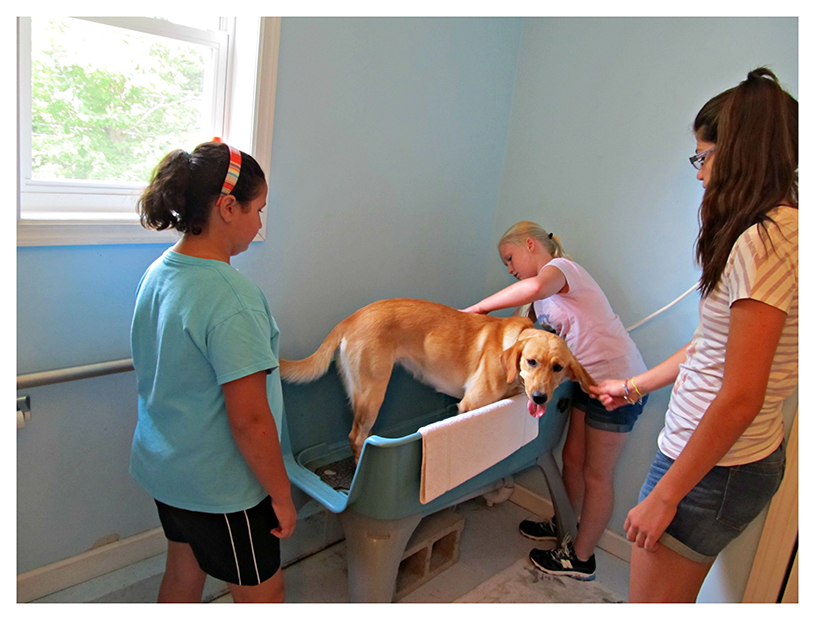
Do you love dogs and being around them? Do you want to see people in need of a Service Dog receive the well-trained dog they deserve? Then the Youth Volunteer Program may be right for you! Here at ECAD, we need volunteers to help us care for our dogs and facilities where we house and train future Service Dogs.
 What things will you be doing?
- Cleaning the kennel and crates
- Grooming dogs
- Exercising dogs
- Scooping poop
- And anything else that needs to be completed to ensure the health and welfare of the Service Dogs in Training
When are the volunteer hours?
Currently we are offering this volunteer opportunity on Saturdays and Sundays in three hour shifts from 9am - 12 noon OR 1pm - 4pm. (These are subject to change)
Youth Volunteer Requirements
- Must be between 12-18 years of age
- Be able to follow directions with limited supervision
- Be available on the weekends for a 3 hour shift
- Have reliable transportation and can easily make it to our Torrington, CT campus
- Can commit for a minimum 6 months
 What is the process?
1. Complete the volunteer application here
2. Participate in a Phone interview
3. Attend an Orientation
Whether you have service learning requirements through your school/organization or you’re just motivated to volunteer because you like dogs, there may be a place for you here at ECAD. Please note, this is a learn to work volunteer opportunity, where you will learn how to perform kennel responsibilities and basic care for dogs.
Help Us Reach Our Goal 
10%
ECAD, Educated Canines Assisting with Disabilities is a 501(c)(3) nonprofit organization and we depend on generosity of people like you to continue changing lives.

ECAD Volunteer Opportunities

There are many ways you can be a part of the miraculous process of turning tiny puppies into confident and mature Service Dogs.